As we begin to reflect on our last units of inquiry for the year, student action becomes a topic of conversation. We know that, as a part of the action cycle (choose, act, reflect), students are expected to take action as a result of their learning. It can be hard to capture student action because it doesn't always happen within the context of the school day. One of our jobs, as PYP educators, is to make sure that our student's parents have a good understanding of the action cycle and are aware of the concepts we are studying in each unit of inquiry. I have developed a very simple parent letter that could be used for this purpose at the beginning of a new unit. Feel free to edit this document to meet your needs.
It's also important that we have a good understanding of what we are looking for when it comes to student action. In Making the PYP Happen (2009), it states that effective action does not need to be grandiose. It begins with the most immediate and basic level: with the self; within the family; within the classroom, the hallways and the playground. Effective action can be a demonstration of a sense of responsibility and respect for self, others and the environment.
In Fahey's book, Ways to Learn Through Inquiry (2012), she gives several examples of student action including ideas. Fahey describes a situation where a preschooler was learning about different homes and came to the realization that not all people have a place to live. As he was playing with counters in his classroom, he created a "town" where all people had a home. This child didn't solve the homeless problems in his community, but the inquiry into homes in his classroom, helped him understand homelessness and he made a change in his thinking. This is taking action! It doesn't have to change the world, just the way you think.
So...in the last few weeks of school, be an observer. Don't let student action pass you by!
Thursday, May 9, 2013

Wednesday, January 9, 2013
Setting the Stage for Inquiry
As teachers begin to launch their fourth units of inquiry for the year, I've been thinking a lot about setting the stage for inquiry. In a unit of inquiry we obviously want the students to be asking questions. This is something we have had lots of discussions about during our PYP meetings. Many of you have expressed concern that it is difficult for students to generate questions or that they often generate low level questions.
If we want students to ask questions, we need to provide them with something that truly sparks curiosity. Something that they can relate to on some level and that they want to learn more about. I think this starts with our provocations.
Before you even introduce the central idea, think about how you want your classroom environment to look during this unit of inquiry. Some things to consider displaying include:
If we want students to ask questions, we need to provide them with something that truly sparks curiosity. Something that they can relate to on some level and that they want to learn more about. I think this starts with our provocations.
Before you even introduce the central idea, think about how you want your classroom environment to look during this unit of inquiry. Some things to consider displaying include:
- Related pictures and vocabulary
- Real world items
- Books and magazines
- Posters
.JPG) |
| The First Graders in Mrs. Hargrave's class are already beginning to wonder about these famous world leaders |
Could someone infer what you might be studying by looking around the room? Will the items you have on display spark questions? Could students predict which transdisciplinary theme the unit will fall under? Could they make a guess as to what the central idea might be?
If students are asking questions before the unit begins, you are setting the stage for a great unit of inquiry!
Sunday, October 21, 2012
Knowlege
Knowledge
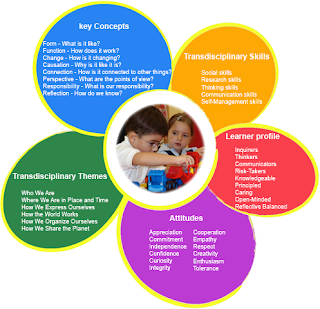
The International Baccalaureate Primary Years Program is a framework for international education. There are five essential elements at the heart of the PYP. They are:
- Knowledge
- Skills
- Concepts
- Attitudes
- Action
Source

Knowledge is an essential element that addresses the question What do we want students to know about? The IB Organization believes that educating students in a set of isolated subject areas, while necessary, is not sufficient. Of equal importance is the need to acquire skills in context, and to explore content that is relevant to students, and transcends the boundaries of the traditional subjects (Making the PYP Happen, 2009).
Like all schools in Council Bluffs, we teach the district adopted curriculum which aligns with the Iowa Common Core Curriculum. Like all IB world schools, we help students make connections within and across disciplines in order to help them develop a deep understanding of important concepts.
IB provides a six transdisciplinary themes that are considered essential in a program of international education. According to the IB organization, these themes:
- Have global significance- for all students in all cultures
- Offer students the opportunity to explore the commonalities of human experience
- Are supported by knowledge, concepts and skills from the traditional subject areas but utilize them in ways that transcend the confines of these subjects, thereby contributing to a transdisciplinary model of teaching and learning
- Will be revisited throughout the students’ years of schooling, so that the end result is immersion in broad-ranging, in-depth, articulated curriculum content
- Contribute to the common ground that unifies the curriculums in all PYP schools
- Who we are- An inquiry into the nature of the self; beliefs and values; personal, physical, mental, social and spiritual health; human relationships including families, friends, communities, and cultures; rights and responsibilities; what it means to be human.
- Where we are in place and time- An inquiry into orientation in place and time; personal histories; homes and journeys; the discoveries, explorations and migrations of humankind; the relationships between and the interconnectedness of individuals and civilizations, from local and global perspectives.
- How we express ourselves- An inquiry into the ways in which we discover and express ideas, feelings, nature, culture, beliefs and values; the ways in which we reflect on, extend and enjoy our creativity; our appreciation of the aesthetic.
- How the world works- An inquiry into the natural world and its laws; the interaction between the natural world (physical and biological) and human societies; how humans use their understanding of scientific principles; the impact of scientific and technological advances on society and on the environment.
- How we organize ourselves- An inquiry into the interconnectedness of human-made systems and communities; the structure and function of organizations; societal decision-making; economic activities and their impact on humankind and the environment.
- Sharing the planet- An inquiry into rights and responsibilities in the struggle to share finite resources with other people and with other living things; communities and the relationships within and between them; access to equal opportunities; peace and conflict resolution.
This framework allows College View teachers to provide students with the knowledge they need to be educated as citizens of a global community.
Thursday, September 27, 2012
Action Cycle
This post was written as a part of the CV PYP blog for parents, but I thought teachers may enjoy it as well: As many of you know, College View is a candidate school for the International Baccalaureate Primary Years Program. One of the essential elements of this program is for students to take action as a result of their learning. We believe that successful inquiry will lead to responsible action, initiated by the student as a result of the learning process.
Student initiated action can take many different forms. Action can be taken by an individual student, groups of students or as a school community. Action may take place at home, at school or in the community.
Our hope is that students will move through the action cycle as a result of their learning. After each unit of inquiry, we hope to give students the opportunity and power to choose to act, to decide on their actions, and to reflect on their actions in order to make a difference in the world.
 |
| IB PYP Action Cycle |
Action can be big or small. Last year, at College View, we had quite the range of student initiated action. After learning about how people rely on one another, a group of 4th grade students raised money for the Red Cross. This was a rather large project that included many students and impacted the community. On a smaller scale, we had a kindergarten student who had learned about life cycles, choose not to pick dandelions on the playground because she knew it would stop the life cycle. Both examples demonstrate how students took action as a result of their learning.
As parents, you can help your child's teacher by letting her know if you see your child taking action as a result of his/her learning. Our hope is that the units of inquiry are not just something they are learning, but that they are something that changes the way they think about our world.
Teachers are just wrapping up their first units on the following concepts. Please let your child's teacher know if you see your child taking action as a result of his/her learning.
- Preschool: Making and keeping friends
- Kindergarten: Rules and routines in the school community
- 1st Grade: Individual rights and responsibilities
- 2nd Grade: Personal Coices
- 3rd Grade: Survival in inter-related systems
- 4th Grade: Interdependence among groups of people
- 5th Grade: Personal, physical, social, spiritual and mental health
Wednesday, October 26, 2011
International Mindedness
As an IB candidate school, we are striving towards the development of international-mindedness. IB defines an internationally minded person as someone who demonstrates the attributes of the learner profile.
When developing the broad concept that your unit of inquiry is centered around and when writing your central idea, one of the criteria was to make sure that it was something that was globally significant. Concepts like change, interdependence and equality matter everywhere throughout the world! Keep these broad concepts in mind as you think about how you will incorporate international mindedness into your unit of inquiry.
The learning occurring in 3rd grade at College View is currently centered around comparisons. The third graders are comparing the culture in the United States with cultures in other countries as they study immigration. The third grade teachers have done a great job of bringing a taste of other cultures into their classrooms.
On Monday, the third graders went to see the Yamato Drummers of Japan. As a follow up to this experience they have scheduled two guest speakers to talk about Japanese culture. The guest speakers will touch on how different areas of the country (rural, urban and suburban) compare to similar areas in the U.S. They will also compare schools in both countries.

The third grade classes have also been asking family members to speak about their ancestors, heritage and culture. Maria (a parent of one of the students in Mrs. Aney's 2/3 combo) spoke to all three classes about Mexican culture and even made tortillas with the students!

These third grade examples are just a few of many wonderful things that are happening at College View to promote internationally minded thinking. Please use the comments section below to share how your grade level is incorporating international mindedness into your current unit of inquiry.
When developing the broad concept that your unit of inquiry is centered around and when writing your central idea, one of the criteria was to make sure that it was something that was globally significant. Concepts like change, interdependence and equality matter everywhere throughout the world! Keep these broad concepts in mind as you think about how you will incorporate international mindedness into your unit of inquiry.
The learning occurring in 3rd grade at College View is currently centered around comparisons. The third graders are comparing the culture in the United States with cultures in other countries as they study immigration. The third grade teachers have done a great job of bringing a taste of other cultures into their classrooms.
On Monday, the third graders went to see the Yamato Drummers of Japan. As a follow up to this experience they have scheduled two guest speakers to talk about Japanese culture. The guest speakers will touch on how different areas of the country (rural, urban and suburban) compare to similar areas in the U.S. They will also compare schools in both countries.

They couldn't take pictures during the performance, but man that's a cute kid at the Orpheum!
The third grade classes have also been asking family members to speak about their ancestors, heritage and culture. Maria (a parent of one of the students in Mrs. Aney's 2/3 combo) spoke to all three classes about Mexican culture and even made tortillas with the students!

Maria explaining that corn was thought to have special powers to the Aztec people. It helped them to be strong and work all day.
These third grade examples are just a few of many wonderful things that are happening at College View to promote internationally minded thinking. Please use the comments section below to share how your grade level is incorporating international mindedness into your current unit of inquiry.
Monday, October 17, 2011
Launching Your First Unit
It's exciting to see teachers begin launching their first Units of Inquiry. Planners are complete, field trips are scheduled and guest speakers are being secured.
As teachers have been planning their first Units of Inquiry, the question of how what we are doing this year is going to look different from other years has come up. First, it needs to be noted that there is no doubt that the teachers at College View are stellar and that you have all created great lessons in the past. Keeping and using those lessons is a perfectly fine thing to do. The lessons may or may not need to be tweaked to fit with your current central idea.
Teaching using the IB skills, concepts, themes, etc. is something that is new to all of us. It's important to keep these in mind as we teach our units. The best way to keep these in the forefront of your mind is to have them displayed in your classroom.
 Unit of Inquiry Display- 4th Grade Classroom, Hubbell Elementary
 Unit of Inquiry Display- 3rd Grade, Walnut Street School
 Unit of Inquiry Display- Kindergarten, Walnut Street School
As you begin organizing your Unit of Inquiry display, it helps to start with broad concepts and then narrow your focus. You can organize your display in a way that makes sense to you. Below I have listed some of the things you may want to include in your display. *Indicates items that are essential to display.
As teachers have been planning their first Units of Inquiry, the question of how what we are doing this year is going to look different from other years has come up. First, it needs to be noted that there is no doubt that the teachers at College View are stellar and that you have all created great lessons in the past. Keeping and using those lessons is a perfectly fine thing to do. The lessons may or may not need to be tweaked to fit with your current central idea.
Teaching using the IB skills, concepts, themes, etc. is something that is new to all of us. It's important to keep these in mind as we teach our units. The best way to keep these in the forefront of your mind is to have them displayed in your classroom.


As you begin organizing your Unit of Inquiry display, it helps to start with broad concepts and then narrow your focus. You can organize your display in a way that makes sense to you. Below I have listed some of the things you may want to include in your display. *Indicates items that are essential to display.
- Concept your unit is centered around (click here if you forgot your concept)
- *Transdisciplinary Theme
- *Central Idea
- *Lines of Inquiry
- *Teacher Questions
- *Student Questions
- Key Concepts you are currently focusing on
- Learner Profile Attributes you will focus on during this unit
- Transdisciplinary Skills you will focus on during this unit
Displays can be built collaboratively as a grade level team. Be sure to keep the pieces you created for your display next year and in the years to come.
For more ideas on what these displays can look like, take a quick tour of our school. I've already seen them popping up in classrooms throughout the building!
Subscribe to:
Posts (Atom)